Solar Wind
The solar wind is a continuous stream of charged particles (mostly protons and electrons) flowing outward from the Sun at hundreds of kilometers per second. Variations in its speed, density, and embedded magnetic field directly influence Earth's magnetosphere and can drive geomagnetic storms, auroral displays, and radio disruptions.
Current Conditions
Speed
-- km/s
Density
-- p/cm³
Temperature
-- kK
Bz (GSM)
-- nT
Bt
-- nT
Solar Wind Plasma (Last 2 Hours)
Plasma data unavailable
Interplanetary Magnetic Field (Last 2 Hours)
Magnetic field data unavailable
Models & Imagery
WSA-Enlil Solar Wind Model
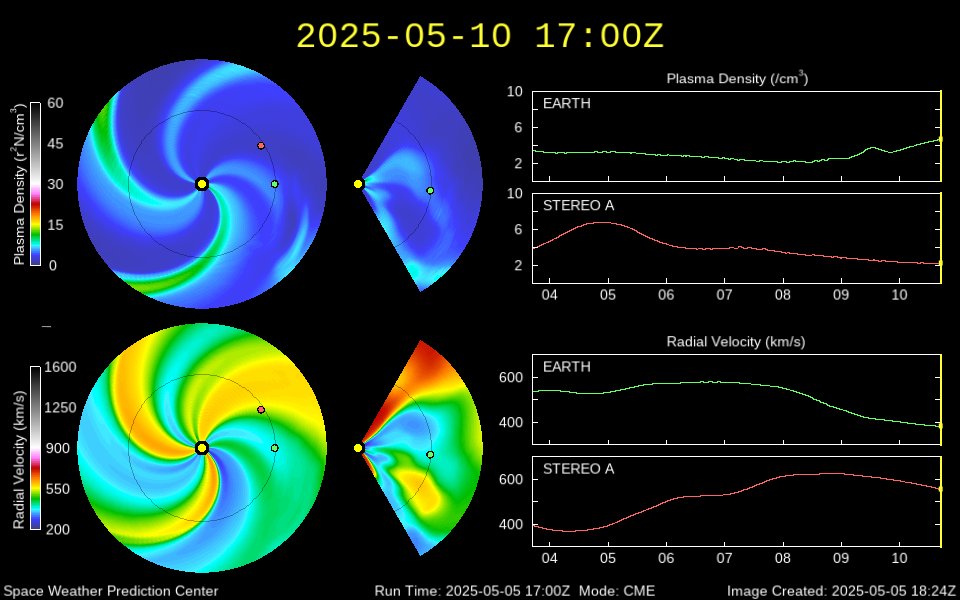
The WSA-Enlil model predicts solar wind speed, density, and interplanetary magnetic field polarity throughout the inner heliosphere. It is used to forecast CME arrival times at Earth.
D-Region Absorption (D-RAP)

The D-Region Absorption Prediction model shows areas of HF radio signal degradation caused by enhanced ionization in the D-layer of the ionosphere, often triggered by solar X-ray flares or energetic particle events.
GOES X-Ray Flux
Real-time X-ray flux measured by GOES satellites. Solar flares appear as sharp spikes and are classified by peak flux: C-class (minor), M-class (moderate), and X-class (major).
What Makes Solar Wind “Geoeffective”?
Not all solar wind disturbances affect Earth equally. The most geoeffective conditions occur when the interplanetary magnetic field (IMF) has a strong southward component (negative Bz) combined with elevated solar wind speed. Southward Bz allows the solar wind to couple efficiently with Earth's magnetosphere through magnetic reconnection, transferring energy that drives geomagnetic storms. High density and speed amplify the dynamic pressure on the magnetosphere. Watch for sustained Bz below -10 nT with speeds above 500 km/s as indicators of significant geomagnetic storm potential.